

Last reviewed: 10 November 2026. Where you stay in China decides more about your trip than the hotel star rating: it decides whether you can walk to dinner, whether a taxi will find you, and whether the front desk can register your passport at 1 a.m. This guide covers the accommodation types, the licensing rule that catches foreigners out, how to book, and what to expect at check-in.
The one rule that catches foreigners out
Chinese hotels need a licence to receive foreign guests. Most mid-range and upper-range hotels have it; many cheap domestic chains, budget guesthouses and family-run inns do not. If you book one of those, you may be turned away at the desk — politely, but firmly — even with a confirmed reservation.
How to avoid it:
- Book through an international platform (Trip.com, Booking.com, Agoda) and filter for “foreign guest accepted” where the filter exists.
- Check the listing’s guest policy — properties that cannot take foreigners usually say so, or have no English reviews.
- If you must stay somewhere cheap, call ahead and ask “can you register a foreign passport?” (能接待外宾吗).
- Hostels in tourist cities are almost always licensed; rural guesthouses often are not.
Accommodation types
| Type | Price band (per night) | Best for | Watch out for |
|---|---|---|---|
| International chain (Marriott, Hilton, Hyatt) | RMB 700–1,800 | Business, reliability, English service | Often in new districts, far from the old town |
| Domestic mid-range (Atour, Ji, Hanting) | RMB 250–500 | Value, cleanliness, good locations | Some branches do not accept foreign passports |
| Boutique / design hotels | RMB 500–1,200 | Character, old-town locations | Small rooms, limited English |
| Hostels | RMB 80–200 (dorm) | Solo travellers, tours, English-speaking staff | Variable quality; check recent reviews |
| Serviced apartments | RMB 400–900 | Stays over two weeks, families | Minimum stay, deposit, fewer services |
| Homestays (minsu) | RMB 200–600 | Rural areas, scenery | Licensing varies; little English |
Booking: which platform to use
Three options, and the differences matter:
- Trip.com — the international arm of Ctrip, China’s dominant booking site. Widest inventory inside China, English interface, foreign cards accepted, and customer service that understands foreign passports. Best default.
- Booking.com / Agoda — good for international chains and for comparing prices, thinner coverage of domestic mid-range hotels.
- Ctrip (携程) — the domestic app has more inventory and lower prices, but the English version is limited and payment can require a Chinese card or Alipay.
Book the first night before you fly and the rest as you go. Chinese hotels rarely sell out outside holiday weeks, and flexibility is worth more than a small discount.
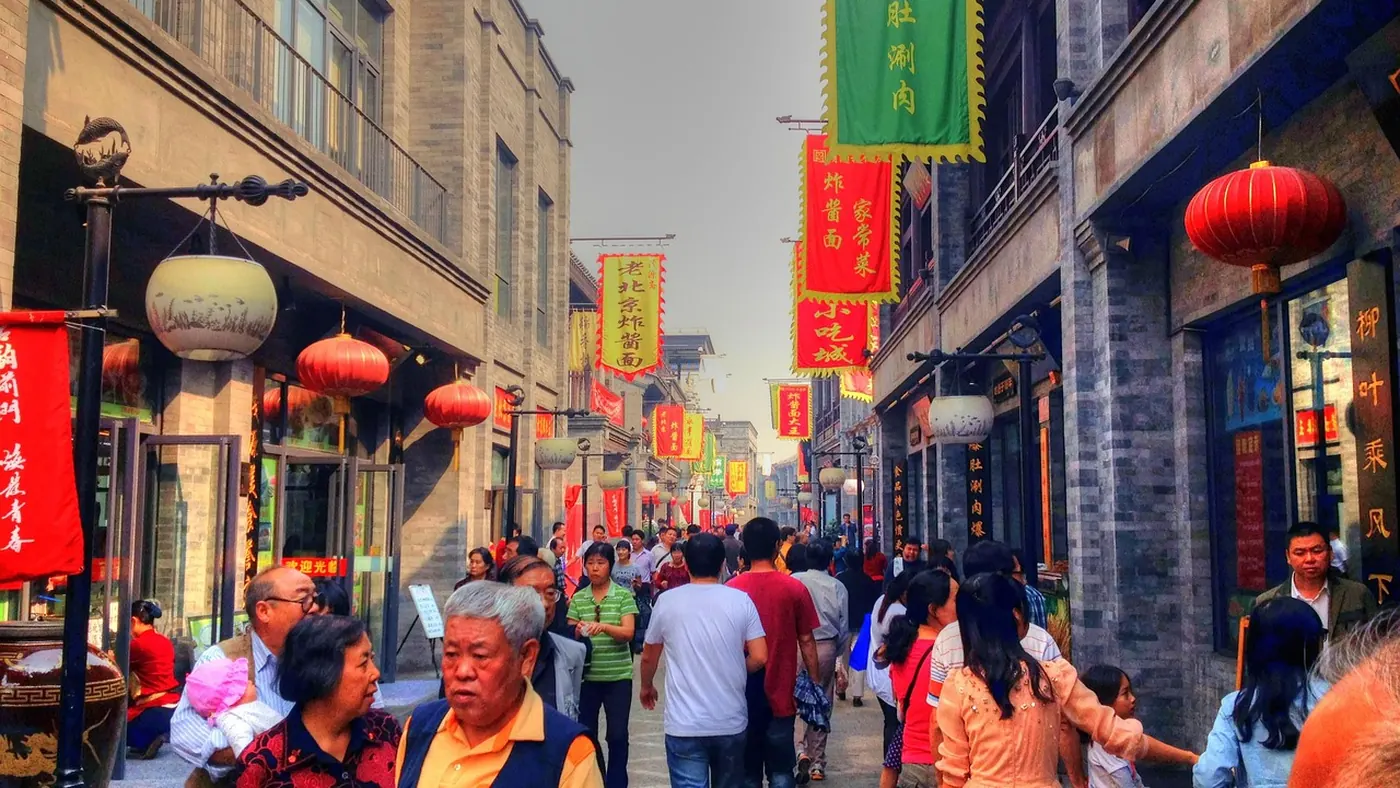
Choosing a location
In Chinese cities, “central” is not a single point. The practical rule is to stay within walking distance of a metro station on a line that connects to the places you want, and to check that the hotel is on the correct side of the city for your arrival station.
- Beijing — Dongcheng for the Forbidden City and hutongs; Sanlitun for restaurants and nightlife; avoid staying near the far-east business district unless you are working there.
- Shanghai — the Former French Concession for walkability, the Bund for the view, Jing’an for transport. Pudong is convenient for the airport and little else.
- Chengdu — Chunxi Road / Taikoo Li for food and transport; the panda base is 40 minutes north, so do not book next to it unless you are leaving early.
- Xi’an — inside the city wall for the Muslim Quarter and the bell tower.
Check the walking time to the metro and the taxi time from the airport before you book; a cheap hotel 20 minutes from a station costs more in taxis than a better-located one.
What happens at check-in
- Passport, always. Every guest must be registered, and the hotel scans your passport. This is why unlicensed properties cannot take you.
- Deposit. Most hotels take a deposit of RMB 100–500 by card or cash, refunded at checkout after a room inspection.
- Check-in time is usually 14:00, checkout 12:00. Early check-in is often possible but not guaranteed; luggage storage is always available.
- Registration slip. Keep the slip the hotel gives you — it proves you registered, which matters if you extend a visa.
- No tipping. Staff do not expect it and may refuse it.
What is and is not in the room
- Always: kettle, tea, slippers, toothbrush and toothpaste, bottled water, air conditioning, Wi-Fi.
- Usually: bathrobe, fridge, safe, iron on request.
- Often missing: face cloths, coffee (it is a tea country), international power sockets (bring a Type A/C/I adapter), and English TV channels outside international chains.
- Never assume: a bathtub, a window (cheap rooms sometimes have none), or a non-smoking floor.
Money and cancellation
Rates are quoted per room, not per person, and usually include tax. Breakfast is often extra (RMB 40–120) and rarely worth it outside international chains — the street breakfast near the hotel is better and cheaper.
Free cancellation is common on international platforms but the window is often 24–48 hours. During Chinese New Year, May Day and National Day week, many properties switch to non-refundable rates — read the policy before you pay.
Problems and how to solve them
The hotel refuses my passport
Stay calm and ask them to help you find a licensed alternative nearby; in practice most will. Then rebook through Trip.com, which flags the issue in listings and can move you.
The room is not what the photos showed
Ask to see another room before accepting. In domestic chains, rooms on higher floors are often better for the same price.
I need an invoice (fapiao)
Ask at check-in, not checkout. You will need your company’s Chinese name and tax number. Hotels issue them readily; small guesthouses often cannot.
I am arriving after midnight
Tell the hotel in advance — some domestic properties release the room if you have not checked in by a certain hour. Keep the confirmation number and the front desk phone number.
Frequently asked questions
Can I stay in an Airbnb in China?
Domestic short-term rentals exist but regulation is tight and many cannot register foreign guests. Hotels are simpler and, for a short trip, usually not more expensive.
Do I need to book far in advance?
Outside holiday weeks, a few days is enough. For Golden Week and Chinese New Year, book months ahead — prices triple and good properties sell out.
Is breakfast worth paying for?
At international chains, yes if you want a Western breakfast. Otherwise eat outside: congee, baozi and soy milk cost RMB 10–20.
Prices and policies change. If something here is out of date, tell us on the contact page.